
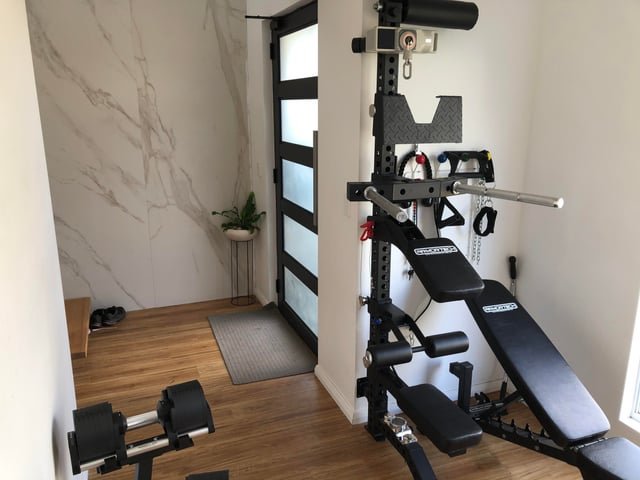
Article-At-A-Glance: Minimalist Strength Home Gym Setup
- You don’t need a squat rack, a barbell, and a full wall of dumbbells — a minimalist home gym built around two core products can deliver real, measurable strength gains.
- The biggest mistake most home gym builders make is spending hundreds on equipment they never use — the right minimalist setup eliminates that waste entirely.
- Fofana covers every major movement pattern — push, pull, legs, and core — making it the single most efficient strength tool for small-space training.
- Recovery is the most overlooked part of any home gym setup — and one device, FlexBeam, is quietly solving that problem for home athletes.
- You can build a functional, effective home gym for under $1,000 — and in some cases, far less — without sacrificing the quality of your training.
Most people overthink building a home gym, and it costs them — in money, in space, and eventually in motivation.
The truth is, the best home gym isn’t the biggest one. It’s the one you actually use. Friction is the enemy of consistency, and a cluttered, expensive, over-complicated setup creates more friction than a commercial gym membership ever could. The minimalist approach cuts through all of that — fewer pieces, smarter choices, and a setup that gets out of your way so you can just train. For those who want a practical framework built around this philosophy, Fofana has become one of the go-to starting points for small-space strength training.
You Don’t Need a Full Gym to Build Real Strength
The fitness industry has done a great job convincing people that more equipment equals better results. It doesn’t. What actually drives strength gains is progressive overload, consistency, and recovery — none of which require a 600-square-foot garage gym to achieve. A well-chosen minimalist setup can hit every major muscle group, support progressive training, and fit inside a bedroom, a living room corner, or a balcony.
Consider this: some of the most effective training tools ever developed — kettlebells, resistance bands, suspension trainers — take up almost no space at all. A single adjustable dumbbell set paired with a pull-up bar covers more movement patterns than most people realize. The key is choosing equipment with a high exercise-to-footprint ratio, meaning every square foot of space your gear occupies should unlock multiple training options.
1. Fofana: The Strength Base That Covers Everything
Fofana is built around a simple but powerful idea — one system should be enough to train your entire body without needing a dozen separate pieces of equipment. For apartment dwellers, basement trainers, and anyone working with limited space, that’s not just a convenience, it’s a game changer.
What Fofana Actually Covers
The four pillars of any complete strength program are push, pull, legs, and core. Miss any one of them consistently and you end up with imbalances, weaknesses, and eventually injuries. Fofana is designed to address all four, which means you’re not patching together a program from three different tools — you’re working from a single, cohesive system.
Here’s how the movement coverage breaks down in practice:
- Push: Chest press variations, overhead pressing, push-up progressions with added resistance
- Pull: Row variations, lat engagement, rear delt and upper back work
- Legs: Squat patterns, hinge movements, single-leg work for unilateral strength
- Core: Anti-rotation, flexion, extension, and stability-based movements
The minimalist rule of thumb: If a single piece of equipment can’t support at least 8 to 10 distinct exercises across multiple movement patterns, it probably doesn’t earn a spot in a small-space gym.
Fofana clears that bar comfortably, which is why it functions as a genuine strength base rather than a supplemental tool.
Why It Works for Small Spaces
Space efficiency isn’t just about the physical footprint of the equipment — it’s also about storage, setup time, and how quickly you can transition between exercises. A setup that takes 10 minutes to assemble before every session creates friction. Fofana is designed to minimize that gap between “I want to train” and “I’m training,” which is one of the most underrated factors in long-term consistency.
For apartment dwellers specifically, noise and floor impact are real concerns. Heavy barbell drops and jumping movements can create problems with downstairs neighbors and building management. A system like Fofana sidesteps those issues entirely while still delivering the resistance and variety needed for progressive strength development.
Who Fofana Is Best For
Fofana is the right fit if you’re working with under 100 square feet of training space, training alone without a spotter, or building your first home gym and want to get it right without overspending. It also works well for intermediate lifters who’ve outgrown resistance bands but aren’t ready to commit to a full barbell setup. If your goal is consistent, full-body strength training in a space-efficient package, Fofana is a logical first investment.
2. FlexBeam: The Recovery Tool Most Home Gym Setups Are Missing
Here’s where most minimalist home gym guides stop — at the training equipment — and leave out the single factor that determines whether your training actually produces results over time: recovery. You can have the most efficient strength setup in the world, but if your muscles aren’t recovering between sessions, you’re just accumulating fatigue without adaptation. For those working with limited space, consider exploring a small space home gym setup that includes essential recovery tools.
What FlexBeam Does and How It Works
The FlexBeam is a targeted red light therapy device designed to accelerate muscle recovery, reduce inflammation, and support tissue repair at the cellular level. It uses near-infrared and red light wavelengths — specifically in the 630nm to 850nm range — to penetrate muscle tissue and stimulate mitochondrial activity. In plain terms, it helps your cells produce energy more efficiently, which speeds up the repair process after training stress.
Unlike full-panel red light therapy setups that require dedicated wall space and a significant investment, FlexBeam is a wearable, targeted device. You wrap it directly around the muscle group you want to treat — a sore quad, a tight lower back, a fatigued shoulder — and let it work for 10 to 20 minutes. It’s portable, storage-friendly, and fits perfectly into the minimalist gym philosophy.
Why Recovery Is the Missing Piece in Most Home Gyms
Most home gym setups are built entirely around training stimulus and completely ignore the other half of the equation. You break muscle tissue down during training — recovery is where it actually gets rebuilt stronger. Skip that step consistently and you hit a wall: persistent soreness, stalled progress, and eventually burnout or injury. A minimalist home gym that includes a recovery tool isn’t over-equipped, it’s complete.
- Muscle soreness that lingers more than 48 hours signals inadequate recovery, not just hard training
- Sleep quality directly impacts muscle protein synthesis — poor sleep undermines even a perfect training program
- Inflammation management between sessions determines how quickly you can train again at full capacity
- Tissue repair at the cellular level requires adequate energy production — exactly what red light therapy supports
The gap between training and recovery tools in most home gyms is significant. People invest in dumbbells, pull-up bars, and resistance bands without a single thought toward what happens in the 48 hours after a session. FlexBeam fills that gap without adding bulk, cost, or complexity to a minimalist setup.
Red light therapy has moved well beyond the wellness fringe. Research published across sports medicine and photobiomodulation journals supports its use for reducing delayed onset muscle soreness (DOMS), improving local circulation, and accelerating tissue recovery. For home gym athletes training without coaches, physiotherapists, or recovery staff, a device like FlexBeam levels the playing field considerably. For those interested in optimizing their home gym setup, exploring compact home gym equipment can further enhance their training environment.
How FlexBeam Keeps You Consistent
Consistency is the single most important variable in any fitness program, and the biggest threat to consistency isn’t laziness — it’s pain and fatigue. When you’re too sore to train, you skip sessions. When you skip sessions, momentum breaks. When momentum breaks, the home gym collects dust. FlexBeam interrupts that cycle by shortening the recovery window between sessions, keeping the body ready to train more frequently without accumulating excessive fatigue.
For a minimalist home gym setup specifically, this matters even more. You’re likely training with higher frequency and lower volume per session — which means recovery turnaround time directly impacts how effective your weekly programming is. A 15-minute FlexBeam session on a sore muscle group the evening after training can mean the difference between training again in 24 hours versus 48. Over weeks and months, that compounds into a significant training volume advantage.
Real Minimalist Home Gym Ideas That Actually Work
Inspiration is useful, but concrete examples are better. The setups below are real-world configurations that work within tight space and budget constraints — no 3,000-square-foot garage required. Each one is built around the minimalist principle of maximum training output per square foot.
Minimalist Home Gym Comparison
Setup Type Space Required Estimated Cost Best For Bedroom / Apartment Gym 50–80 sq ft $200–$500 Beginners, apartment dwellers Minimalist Garage Gym 100–150 sq ft $400–$800 Intermediate lifters, families Budget Powerlifting Setup 150–200 sq ft $600–$1,000 Strength-focused athletes Backyard CrossFit Setup 200+ sq ft $300–$700 Conditioning-focused athletes
Notice that even the most advanced setup on this list caps out at $1,000. That’s the ceiling, not the floor. Many highly effective minimalist gyms come in well under $500 when equipment is chosen strategically and second-hand options are considered.
The common thread across every successful minimalist setup is intentionality. Every piece of equipment earns its place by covering multiple movement patterns, fitting the available space, and supporting the specific training goals of the person using it. There’s no room for impulse purchases or novelty gadgets in a space-constrained gym.
The Bedroom Gym: Proof You Don’t Need Much Space
A bedroom gym is the ultimate test of minimalist principles — and it passes with flying colors when set up correctly. The key is treating the floor space as a training zone, not a storage zone. Equipment lives stored away when not in use, and the room doubles as a functional gym when needed. This isn’t a compromise; it’s smart design.
A well-configured bedroom gym covering full-body strength training can be built around just a handful of items. The goal is zero wasted purchases — every item earns its floor space.
- Fofana strength system — full-body coverage, compact storage footprint
- Doorframe pull-up bar — zero permanent installation, stores in a closet
- Adjustable resistance bands set — five resistance levels, fits in a drawer
- Folding exercise mat (6mm thickness minimum) — doubles as floor protection and core training surface
- FlexBeam recovery device — stores on a nightstand, used post-session in bed or on the floor
That’s five items covering strength training, pulling movements, mobility work, floor training, and recovery. Total storage footprint: under two square feet. Total training potential: your entire body, every session. For more ideas, check out this guide on compact home gym equipment.
The Backyard CrossFit Setup on a Budget
Outdoor training removes the space constraint entirely and opens up conditioning work that simply isn’t possible indoors. A backyard CrossFit-style setup doesn’t need a rig, a rower, and a wall of barbells — it needs a few well-chosen implements and a patch of grass. A set of kettlebells (16kg and 24kg cover most athletes), a jump rope, a pull-up bar anchored to a fence post or free-standing frame, and a plyo box handle the vast majority of CrossFit-style programming. Add a medicine ball for wall balls and ground-to-overhead work and you have a conditioning setup that rivals most commercial gym offerings at a fraction of the cost. For more ideas on optimizing your space, check out this guide on apartment workout equipment.
Second-hand equipment is particularly advantageous here. Kettlebells, plyo boxes, and pull-up rigs hold up extremely well over time and are frequently listed on marketplace platforms at 40 to 60 percent below retail. A complete backyard conditioning setup assembled from second-hand gear can realistically come in under $300.
The Budget Powerlifting Home Gym
Powerlifting at home on a budget is more achievable than most people think. The non-negotiables are a barbell, plates, and something to squat and bench from — everything else is optional. A 20kg Olympic barbell, 200lbs of bumper or iron plates, and a flat bench with J-hooks anchored to a squat stand covers the squat, bench press, and deadlift. That’s the entire sport. Rep Fitness, Rogue, and Titan Fitness all offer entry-level barbell and rack combinations in the $400 to $700 range that are built to handle serious loads without the premium price tag of competition-grade equipment.
The one addition worth budgeting for in a powerlifting setup is proper flooring. A single layer of 3/4-inch horse stall mats — available from agricultural supply stores at roughly $40 to $50 per mat — protects both your floor and your equipment while reducing noise transfer. Two mats cover a standard lifting platform and represent one of the highest-value upgrades in any budget home gym.
Essential Gear for a Minimalist Home Gym on Any Budget
Cutting through the noise of the fitness equipment market comes down to one filtering question: does this piece of equipment make me stronger, more mobile, or better recovered? If the answer is yes to at least two of those, it belongs in the conversation. If it only ticks one box, it needs to earn its place through exceptional performance in that category.
Budget is always a factor, but price alone shouldn’t drive equipment decisions. A $30 piece of equipment that you use five times a week is a better investment than a $300 piece that collects dust. Prioritize utility, durability, and space efficiency — in that order.
The Core Equipment List
There’s a tier system that works for minimalist home gym building regardless of budget. Start with Tier 1 and only move to Tier 2 once you’ve maxed out the training potential of what you already have. Most people never need to go beyond Tier 2.
Tier 1 is the foundation — the equipment that covers 80 percent of your training needs and should be the first money spent. This is where Fofana lives, alongside a quality pull-up bar and a mat. These three items alone can sustain a complete strength training program for months before you hit a ceiling.
Tier 2 adds variety and specialization without blowing up the space or the budget. This is where adjustable dumbbells, kettlebells, and resistance bands come in — tools that expand exercise variety and allow more precise progressive overload across different movement patterns.
Minimalist Home Gym Equipment Tiers
Tier Equipment Approx. Cost Training Coverage Tier 1 — Foundation Fofana system, doorframe pull-up bar, 6mm mat $150–$350 Full-body strength, pulling, core, floor work Tier 2 — Expansion Adjustable dumbbells, resistance bands, kettlebell (16kg) $150–$400 Isolation work, progressive overload, conditioning Tier 3 — Specialization Barbell + plates, squat stand, plyo box $400–$700 Powerlifting movements, explosive training Recovery FlexBeam red light therapy device Investment Muscle repair, inflammation reduction, consistency
Most minimalist home gym setups never need to move past Tier 2. The combination of a high-quality strength system like Fofana, a pull-up bar, adjustable resistance tools, and a recovery device like FlexBeam covers the full spectrum of training and recovery needs for the vast majority of fitness goals — all within a footprint that fits comfortably in an apartment, a spare bedroom, or a garage corner.
How to Buy Smart: New vs. Second-Hand
The second-hand equipment market for home gyms is genuinely excellent right now. Platforms like Facebook Marketplace, Craigslist, and OfferUp are consistently stocked with quality barbells, dumbbells, kettlebells, and benches from people who bought gear during the pandemic fitness boom and never followed through. Cast iron plates, in particular, hold up indefinitely — a 45lb plate from 1995 performs identically to one made last year. Buying second-hand on items like these is a no-brainer.
That said, some equipment is worth buying new. Anything with moving parts — adjustable dumbbells with locking mechanisms, resistance bands with clip attachments, pull-up bars with swivel grips — benefits from the warranty and quality assurance that comes with a new purchase. The same applies to recovery devices like FlexBeam, where the electronics and light therapy components need to be verified and under warranty to guarantee they’re operating at the correct wavelengths. A simple rule: buy iron second-hand, buy tech new.
Consistency Beats Intensity: The Minimalist Gym Mindset
The minimalist home gym isn’t just a space-saving strategy — it’s a philosophy. It’s a commitment to removing every excuse that stands between you and the training session. No commute, no wait for equipment, no membership fees, no opening hours. Just you, a small and intentional collection of tools, and the work. The athletes who see the best long-term results from home gym setups aren’t the ones with the most equipment — they’re the ones who show up consistently, train with purpose, and recover properly between sessions. Build your minimalist gym around that mindset, and the results will follow.
Frequently Asked Questions
Building a minimalist home gym raises a lot of practical questions — especially around what’s truly essential versus what the fitness industry just wants you to buy. For those interested in setting up a small space home gym, the answers below cut through the noise and give you what you actually need to know before spending a dollar.
What Is the Minimum Equipment Needed for a Minimalist Home Gym?
The minimum effective setup is a strength training system that covers push, pull, legs, and core — plus a surface to train on. Practically speaking, that’s a system like Fofana paired with a doorframe pull-up bar and a quality exercise mat. Those three items, used consistently with a progressive overload approach, can sustain months of effective full-body strength training. Everything beyond that is an upgrade, not a requirement.
Can You Build Real Strength With Just 2 Products?
Yes — and the two-product framework outlined in this article proves it. Fofana handles the training stimulus across every major movement pattern, and FlexBeam handles the recovery between sessions. Strength is built during recovery, not during training itself — so a setup that addresses both sides of that equation is fundamentally complete. The limiting factor for most people isn’t equipment, it’s program design and consistency. Two well-chosen products, used intelligently over time, will outperform a poorly used garage full of gear every single time.
Is a Minimalist Home Gym Worth It for Apartment Dwellers?
A minimalist home gym is arguably the best fit for apartment dwellers specifically. The upfront equipment cost is typically recovered within three to four months compared to a standard gym membership. Training happens on your schedule, in your space, with zero commute time. And with the right equipment — low noise, minimal floor impact, compact storage — it integrates into apartment living without disruption. The REP Fitness Compact Home Gym Package and similar space-efficient configurations prove that a productive training environment doesn’t require dedicated room square footage. A cleared corner of a living room is genuinely enough.
How Does FlexBeam Help With Home Gym Recovery?
FlexBeam delivers targeted red light therapy — using wavelengths in the 630nm to 850nm range — directly to the muscle tissue that needs recovery support. At the cellular level, this stimulates mitochondrial activity and increases ATP production, which accelerates the repair process following training-induced muscle damage. The practical result is reduced delayed onset muscle soreness, faster return to full training capacity, and better overall training frequency over time. For those interested in enhancing their home gym setup, consider exploring compact home gym equipment that complements recovery tools like FlexBeam.
For home gym athletes specifically, FlexBeam replaces a range of recovery modalities — foam rollers, massage guns, ice baths — with a single wearable device. A 10 to 20 minute session applied directly to a worked muscle group in the hours following training is the recommended protocol. It stores flat, requires no assembly, and adds zero square footage to your gym footprint — making it a perfect fit for the minimalist setup philosophy.
What Is the Cheapest Way to Start a Home Gym?
Start with bodyweight training and a single resistance tool. A doorframe pull-up bar at $25 to $40 and a set of resistance bands at $20 to $40 gives you access to hundreds of exercise variations covering every muscle group — for under $80 total. That’s a legitimate starting point, not a compromise.
From there, add equipment in order of training impact. A quality strength system like Fofana is the logical next step, replacing multiple single-use tools with one comprehensive system. Adjustable dumbbells follow, then kettlebells, then barbell equipment if your goals require it. The key is resisting the urge to buy everything at once before you’ve established consistent training habits — equipment bought before habits are formed tends to become expensive furniture. For those starting out, exploring budget home gym setups can provide valuable insights.
Second-hand markets are your best friend at the budget end. Facebook Marketplace regularly lists complete dumbbell sets, kettlebells, and benches at 40 to 60 percent below retail. Buying second-hand on iron equipment and new on tech-based items like FlexBeam gives you the best of both worlds — durability and warranty protection where each matters most.
If you’re serious about building a home gym that actually works long-term — one that trains you efficiently, recovers you properly, and fits the space you actually have — Fofana is the strength foundation worth starting with, and the complete two-product system outlined here is all you need to get there. For more ideas on creating a compact gym setup, check out this guide on compact home gym equipment.
Leave a Reply