
BestProductsForMen.org participates in affiliate programs, which means we may earn a commission if you click on a link and make a purchase. This comes at no additional cost to you. We only recommend products we personally trust, use, or believe will provide value to our readers.
Our goal is to provide honest, helpful reviews and recommendations so you can make informed decisions.
Grooming for Quiet Confidence
Grooming isn’t about vanity. It’s about reducing daily friction. When you feel physically put together, your brain has one less thing to worry about. This guide is for men who want clean, practical upgrades without trends, hype, or overwhelm.
Best Beard Grooming Essentials: Why This Matters
If grooming feels awkward, overwhelming, or like something you were never really taught, you are not alone. A lot of quiet, thoughtful guys reach adulthood having never had anyone calmly walk them through this stuff without judgment or hype. If you are soft spoken, anxious, or just unsure where to start, this article is here to slow things down and walk with you step by step. You do not need to become flashy, aggressive, or someone you are not. You just need a few reliable tools, a simple understanding of what each one does, and permission to learn at your own pace. Think of this as a steady hand on your shoulder while you figure out what works for you and what makes you feel a little more confident when you look in the mirror.
Key Takeaways
- A quality beard trimmer with multiple length settings is the foundation of any effective beard grooming toolkit
- Using the right combination of combs and brushes helps train beard hair to grow in the desired direction while distributing natural oils
- Beard oils and balms serve different purposes – oils moisturize skin and hair while balms provide styling control
- The Beard Club offers premium grooming tools designed specifically for facial hair maintenance
- A complete beard care routine requires both mechanical tools for shaping and care products for health and appearance
Growing an impressive beard isn’t just about genetics—it’s about proper maintenance. Whether you’re sporting a 5 o’clock shadow or a full Viking beard, having the right tools makes all the difference between looking rugged and looking unkempt. The booming men’s grooming industry now offers specialized solutions for every facial hair challenge.
Navigating the world of beard grooming can feel overwhelming with the sheer number of products available today. However, understanding which tools are essential can simplify your routine while maximizing results. The Beard Club offers a comprehensive range of beard care products designed specifically to address the unique needs of facial hair, helping men achieve that enviable, well-maintained mane without unnecessary complexity.
As professional barber Conrad explains, beard care products fall into two categories: tools (trimmers, combs, brushes) and care products (oils, washes, styling products). Getting these fundamentals right creates the foundation for excellent beard health and appearance. Let’s explore the essential tools every bearded man should own.
Article-at-a-Glance
This comprehensive guide covers the ten most essential beard grooming tools every man should own, from precision trimmers to specialized conditioners. We’ll explore how each tool contributes to beard health and appearance, offering expert insights on selecting quality products that deliver results. You’ll discover proper techniques for using each item and how to integrate them into an efficient grooming routine. For more on essential items, check out our professional man essentials.
Beyond just product recommendations, we’ll dive into the science behind effective beard care, explaining how different tools address specific challenges like uneven growth, dryness, and styling difficulties. By the end of this article, you’ll have a clear understanding of which tools deserve a place in your grooming arsenal and how to use them for maximum impact.
Why Every Bearded Man Needs the Right Tools
A well-groomed beard doesn’t happen by accident. Behind every enviable facial mane is a deliberate routine supported by quality tools designed specifically for facial hair. Regular haircare products and techniques simply don’t address the unique challenges beards present—coarser texture, different growth patterns, and proximity to sensitive facial skin all require specialized approaches.
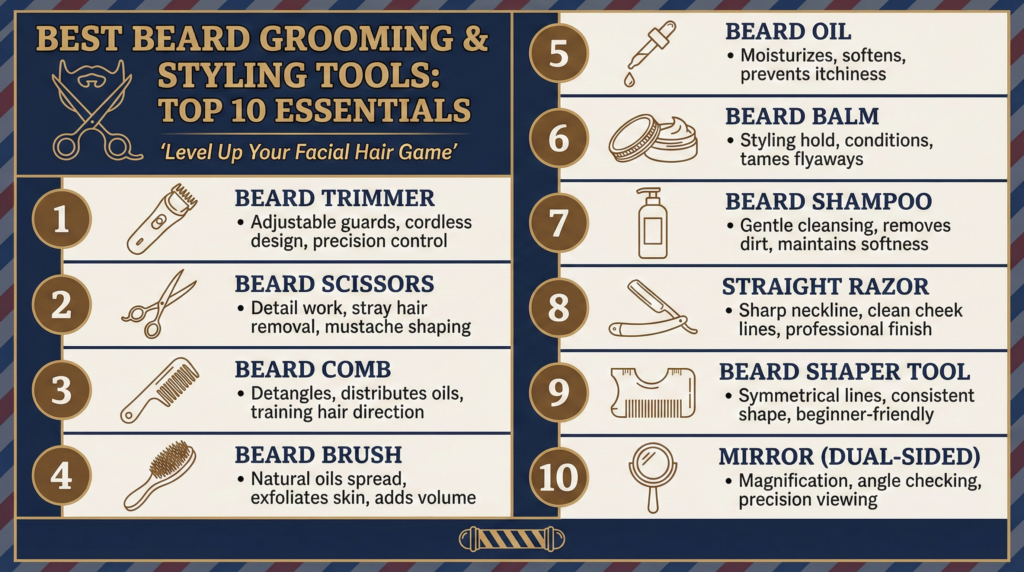
The 10 Essential Beard Grooming Tools Every Man Should Own
After consulting grooming experts and testing countless products, we’ve identified the ten beard tools that deliver the most value. Each serves a distinct purpose in maintaining beard health, shape, and appearance. While individual needs may vary slightly based on beard type and style, these essentials form the core of any effective beard care arsenal.
1. Professional Beard Trimmer
The beard trimmer stands as the cornerstone of your grooming toolkit. Unlike standard hair clippers, quality beard trimmers feature precision blades designed for facial hair’s unique texture and the detailed work beard shaping requires. Look for models with multiple length settings, sharp stainless steel blades, and ergonomic design for maximum control. The best trimmers maintain their edge through hundreds of uses and offer both corded and cordless functionality for flexibility.
2. Quality Beard Scissors
While trimmers handle the bulk of shaping work, professional-grade scissors allow for precision detailing impossible to achieve with electric tools. These specialized scissors feature shorter, sharper blades than regular hair scissors, providing the control needed for snipping individual hairs and perfecting your mustache line. Invest in scissors with micro-serrated edges to prevent hair from slipping during cuts and a comfortable grip to maintain steady hands during detailed work.
3. Wide-Tooth Beard Comb
The humble beard comb is perhaps the most underrated tool in beard care. Unlike plastic drugstore combs, proper beard combs are typically crafted from wood, horn, or cellulose acetate to prevent static electricity that damages hair and creates frizz. The wide-tooth design navigates through beard hair without pulling or causing breakage, especially important for longer styles. Daily combing not only detangles but also trains beard hair to grow in your desired direction, creating a fuller, more uniform appearance.
Blade Quality and Material
When it comes to beard trimmers, blade quality is the single most important factor determining performance and longevity. Premium trimmers feature self-sharpening blades made from high-carbon stainless steel that maintains its edge through hundreds of trimming sessions. These blades cut cleanly through coarse facial hair without pulling or causing irritation, which is crucial for sensitive skin. For more on essential grooming tools, check out The Ultimate Guide to Men’s Essentials.
Titanium-coated blades offer superior corrosion resistance and typically stay sharper longer than standard stainless steel. This coating reduces friction during trimming, resulting in less heat buildup that can irritate skin. For men with particularly coarse beards, ceramic blades provide another excellent option as they remain cooler during extended use and maintain their edge up to five times longer than steel alternatives.
Beyond the blade material itself, the cutting angle matters significantly. Professional-grade trimmers feature blades precision-ground at the optimal 45-degree angle for efficient cutting without damaging the hair shaft. This results in cleaner, more precise lines and reduces the risk of ingrown hairs that commonly occur when dull blades tear rather than cleanly cut facial hair.
Look for trimmers with detachable blade systems that allow for thorough cleaning and disinfection between uses. These systems not only promote better hygiene but also extend the life of your trimmer by preventing oil and hair buildup that can compromise cutting performance. Many premium models include specialized blade oil and cleaning brushes to maintain optimal cutting efficiency.
Pro Tip: Even self-sharpening blades benefit from regular maintenance. Apply a drop of blade oil weekly and brush away hair clippings after each use to maximize blade life and performance. Most professional barbers recommend replacing blades every 12-18 months depending on usage frequency and hair coarseness.
Battery Life and Charging Capabilities
The best beard trimmers now feature lithium-ion batteries offering 60+ minutes of continuous runtime on a single charge, freeing you from the constraints of corded operation. Look for models with quick-charge capabilities that provide enough power for a complete trim in just 5 minutes of charging—perfect for those mornings when you’ve forgotten to plug in overnight. Many premium trimmers now include battery level indicators that eliminate the frustration of unexpected power loss mid-trim. For more grooming tips, check out this Manscaped review.
Adjustable Length Settings
Versatility in length settings separates professional-grade trimmers from basic models. Top-tier trimmers offer precise length adjustments in 0.5mm increments, allowing for exact control over beard length and style. Rather than settling for limited fixed-length guards, invest in a trimmer with a built-in adjustable dial or digital control system that provides consistent results across your entire beard. This precision becomes particularly important for popular styles like the tapered beard, which requires seamless transitions between different lengths from cheeks to jawline. For more insights on maintaining your beard, check out these beard maintenance tips.
Waterproof Features for Wet/Dry Use
Fully waterproof trimmers provide versatility that dramatically simplifies beard maintenance. These models allow for trimming in the shower (where steam softens facial hair for easier cutting) and can be rinsed directly under running water for effortless cleaning. Beyond convenience, wet trimming often results in less skin irritation, especially for men with sensitive skin or acne-prone complexions. When selecting a waterproof trimmer, verify it’s rated IPX7 or higher for complete water immersion protection rather than merely “water-resistant” models that can only handle light splashes.
The Science of Proper Beard Combing and Brushing
The humble comb and brush might seem like afterthoughts compared to electric trimmers, but they’re foundational to proper beard care. These tools distribute natural oils from the skin throughout the beard hair, preventing dryness while training growth patterns and identifying areas needing trimming attention. Regular combing and brushing also exfoliate the skin beneath your beard, preventing the dreaded “beardruff” that plagues many facial hair enthusiasts.
The material of your combing tools matters significantly. Natural materials like wood and horn generate minimal static compared to plastic alternatives, reducing frizz and damage to the hair cuticle. Similarly, genuine boar bristle brushes—as opposed to synthetic versions—more effectively distribute sebum throughout the beard while providing the ideal balance of firmness and gentleness for facial hair.
When to Use a Comb vs. a Brush
Understanding when to reach for a comb versus a brush transforms your beard care routine’s effectiveness. Combs excel at detangling and precise styling, making them ideal for longer beards and creating defined lines. Brushes, meanwhile, provide superior distribution of natural oils and beard products while stimulating blood flow to the follicles through gentle exfoliation of the underlying skin. For optimal results, most grooming experts recommend starting with a brush to distribute oils and remove loose hairs, then following with a comb for final detangling and styling—especially before trimming to ensure hairs stand at their true length for even cutting.
Proper Technique for Different Beard Lengths
Short beards (under 1 inch) benefit most from daily brushing with a soft boar bristle brush, working in small circular motions that stimulate skin and train growth patterns. The brush’s compact bristles can reach the skin beneath short facial hair, preventing flaking while distributing natural oils that keep hair healthy. For more on maintaining a well-groomed appearance, check out this guide to professional man essentials.
For medium to long beards (over 1 inch), incorporate both tools: start with a wide-tooth comb to gently work through any tangles, working from the bottom up to avoid pulling. Follow with a firm boar bristle brush, stroking downward in the direction of hair growth to train the beard and create a more uniform appearance. This two-step approach prevents breakage while maximizing style control and beard health.
Training Your Beard Growth Direction
Beard hair naturally grows in different directions across regions of your face, creating an uneven appearance if left unchecked. Regular brushing and combing gradually train these hairs to grow in your desired direction through a process similar to muscle memory. For optimal results, brush your beard in the morning after showering (when hair is most malleable) and again after applying beard oil when the hair is receptive to reshaping.
Consistency is the key to effective training. Daily grooming sessions of just 1-2 minutes teach facial hair to follow your preferred patterns, gradually reducing cowlicks and unruly patches. For stubborn areas, apply slightly more pressure with your brush while the beard is still damp, then follow immediately with a comb to reinforce the direction. Within 2-3 weeks of consistent training, most men notice significantly improved growth patterns and easier styling.
Beard Oils and Balms: What’s the Difference?
The distinction between beard oils and balms extends far beyond their consistency. Oils provide hydration and conditioning without hold, making them ideal for daily maintenance and addressing skin issues beneath your beard. Balms, with their beeswax and butter content, deliver moderate styling hold alongside nourishment, making them better suited for shaping and taming unruly beards. For more insights on maintaining your beard, check out this beard maintenance guide.
Understanding when to use each product optimizes their benefits. Oils work best as daily conditioners applied to clean, slightly damp beards, while balms excel as styling agents applied to dry beards before heading out. Many men with longer or particularly dry beards successfully layer both products—oil first for hydration, followed by a small amount of balm for control and shape retention throughout the day.
Oil Benefits for Skin and Hair Health
Quality beard oils penetrate both hair and the underlying skin, addressing the root causes of common beard problems. The carrier oils (typically jojoba, argan, or grapeseed) mimic your skin’s natural sebum, preventing the dryness that leads to itching and flaking without clogging pores. These lightweight oils absorb quickly, conditioning beard hair from the inside out rather than simply coating the surface.
The molecular structure of premium beard oils allows them to penetrate the hair shaft, improving elasticity and reducing breakage. This is particularly beneficial for men with coarse or curly beard hair that’s prone to splitting and damage. Regular application strengthens the hair cuticle, creating a protective barrier against environmental damage while improving overall beard texture.
Beyond cosmetic benefits, many beard oils contain essential oils with antimicrobial properties that maintain healthy skin beneath your beard. Tea tree, cedarwood, and eucalyptus oils help prevent bacterial and fungal issues that commonly arise in the warm, moist environment under thicker beards. This makes quality oils particularly valuable for men who experience irritation, redness, or acne beneath their facial hair. For those interested in a comprehensive selection of grooming essentials, check out The Ultimate Guide to Men’s Essentials.
Balm Benefits for Styling and Control
Beard balms offer a unique combination of conditioning and styling benefits thanks to their carefully formulated blend of carrier oils, butters, and beeswax. The butter components (typically shea or cocoa) provide deep conditioning for coarse facial hair, while the beeswax delivers the hold necessary for shaping and taming flyaways. This dual-action formula makes balms particularly valuable for men with longer, wilder beards that require structural support throughout the day.
Beyond styling, quality balms create a protective barrier that shields beard hair from environmental damage including wind, pollution, and UV exposure. This protective coating locks moisture into the hair shaft while preventing the drying effects of harsh weather conditions. Many premium balms also incorporate natural protectants like vitamin E that neutralize free radicals and prevent premature aging of both hair and underlying skin.
How to Apply Each Product Correctly
Proper application technique maximizes the effectiveness of both oils and balms. For oils, start with clean, slightly damp beard hair to enhance absorption. Dispense 3-8 drops (depending on beard length) onto your palms, rub hands together to warm the oil, then work thoroughly through your beard using fingertips to ensure the product reaches the skin underneath. Follow with a beard brush to distribute the oil evenly from roots to tips.
Balm application requires a slightly different approach. Scoop a small amount (pea-sized for shorter beards, dime-sized for longer styles) and rub between palms until completely melted. Apply to a completely dry beard, working from the sides toward the center and bottom to top. Use a beard comb immediately after application to evenly distribute the product and style as desired. Allow 1-2 minutes for the balm to set before heading out for maximum hold throughout the day.
Advanced Styling Tools for the Modern Beardsman
As beard styles become increasingly sophisticated, specialized tools have emerged to help men achieve magazine-worthy results. These advanced implements take beard grooming beyond basic maintenance into the realm of precise styling, allowing for creative expression through facial hair. For those committed to maximizing their beard’s potential, these specialized tools represent the next level in grooming technology.
Heated Brushes and Straighteners
Heated beard tools have revolutionized styling options for men with wavy, curly, or unruly facial hair. These specialized devices apply controlled heat directly to beard hair, temporarily altering its structure for a straighter, more managed appearance. Modern beard straighteners feature ceramic plates or bristles that distribute heat evenly while minimizing damage, alongside adjustable temperature settings that accommodate different hair types and thicknesses. For more grooming essentials, explore our guide on professional man essentials.
For optimal results, always apply a heat protectant product before using heated tools, and limit straightening to 2-3 times weekly to prevent moisture loss and damage. The best technique involves working in small sections, holding the tool at a 45-degree angle away from your face, and moving continuously to avoid concentrating heat in any one area. Most men find that temperatures between 300-350°F provide sufficient straightening without compromising beard health. For more on essential grooming techniques, check out The Ultimate Guide to Men’s Essentials.
Beard Dyes and Coloring Products
Beard-specific dyes address the unique challenges of coloring facial hair, which tends to be more resistant to color than scalp hair. These specialized formulations penetrate coarse beard hair effectively while minimizing skin staining and irritation. Unlike regular hair dyes, quality beard colorants typically contain lower levels of ammonia and additional conditioning agents to maintain beard softness and health during the coloring process.
When selecting a beard dye, choose a shade slightly lighter than your desired result, as facial hair absorbs color more intensely than head hair. For the most natural appearance, many professional barbers recommend a two-tone approach that mimics natural beard coloration—slightly darker at the base and lighter at the tips. Always perform a patch test 48 hours before application to prevent allergic reactions, which are more common with facial dyes due to the sensitive skin of the face. For more grooming tips, consider exploring professional man essentials that can enhance your daily routine.
Specialty Waxes for Mustache Styling
Mustache waxes provide significantly stronger hold than balms, making them essential for sculptural styles like handlebars, English curls, or the Hungarian point. These specialized products contain higher concentrations of beeswax and often include hardening resins that create all-day hold capable of defying gravity. The best mustache waxes balance this strong hold with conditioning ingredients that prevent brittleness and breakage during wear and removal. For more on maintaining a professional look, check out our guide on professional man essentials.
Creating Your Morning Beard Care Routine
Consistency transforms good beard care products into great results. Establishing a daily routine that addresses cleansing, conditioning, and styling ensures your beard remains healthy while maintaining your desired appearance. The most effective routines balance thoroughness with efficiency, recognizing that even the most dedicated beardsman has limited morning time.
The sequence of your routine matters significantly. Always begin with cleansing, which prepares the beard and skin for subsequent products. Follow with conditioning treatments (oils or balms) that perform best on clean hair. Complete the process with styling, using mechanical tools like combs and brushes to distribute products and create your desired shape.
Adjusting your routine seasonally optimizes beard health throughout the year. Winter typically requires additional moisture from richer oils and balms to combat dry indoor heating, while summer may necessitate lighter products and more frequent cleansing to address increased sweat and oil production. This seasonal approach prevents common issues like winter dryness and summer frizz before they start.
Quick 5-Minute Routine
Even on rushed mornings, a streamlined beard care routine maintains your facial hair’s health and appearance. Start by rinsing your beard with warm (not hot) water, which opens pores and softens hair without stripping natural oils. Apply a pea-sized amount of beard wash every other day, working it thoroughly into the skin beneath before rinsing completely. On non-wash days, water alone sufficiently refreshes most beards.
After patting your beard mostly dry with a towel, immediately apply 3-5 drops of beard oil, focusing on the skin beneath and distributing throughout with your fingers. Follow with 3-5 strokes of a boar bristle brush in your desired growth direction to distribute the oil evenly and tame major flyaways. Finish with a quick pass of your comb to create final definition and identify any areas needing touch-up trimming (though save actual trimming for days when you have more time).
Weekly Deep Conditioning Treatment
Dedicating 15-20 minutes weekly to a more intensive conditioning process prevents common beard problems and maintains optimal health. Begin with thorough cleansing using a specialized beard shampoo, followed by a beard-specific conditioner left in for 3-5 minutes to penetrate coarse facial hair. After rinsing, apply a double dose of your regular beard oil or a specialized deep conditioning treatment, then wrap your beard in a warm, damp towel for 10 minutes to enhance penetration through heat and steam. Finish by rinsing with cool water to close the cuticle, then apply your regular styling product.
Best Beard Tools for Travel
Maintaining your beard routine while traveling presents unique challenges that specialized travel tools address effectively. Rather than compromising your grooming standards on the road, compact versions of essential tools ensure consistency without overloading your luggage. The best travel beard kits balance size reduction with functionality, providing full-sized results from travel-friendly packages.
Compact Options That Don’t Sacrifice Quality
Multi-functional tools save valuable space without compromising performance. Look for travel trimmers with multiple attachment heads that replace several full-sized tools—the best models include precision detailers, nose hair trimmers, and adjustable guards in a single compact unit. Similarly, double-sided combs featuring both wide and fine teeth eliminate the need to pack multiple combing tools. For beard products, opt for solid versions of oils and balms that bypass TSA liquid restrictions while delivering identical benefits to their traditional counterparts.
TSA-Friendly Beard Kit Essentials
Navigating airport security requires careful consideration of both tool design and product formulations. Electric trimmers with travel locks prevent accidental activation in transit, while removable blades can be packed separately when necessary. For beard care products, solid balms are inherently TSA-compliant, while oils should be transferred to approved 3.4oz containers and sealed in requisite clear bags. Pre-assembled travel kits from premium brands like The Beard Club often include TSA-compliant versions of their most popular products, eliminating guesswork while ensuring you maintain your routine regardless of destination.
Invest in Your Image: Why Quality Matters
The distinction between budget beard tools and professional-grade equipment becomes apparent through daily use and long-term results. Premium tools feature better materials, more precise engineering, and thoughtful design that enhances both performance and longevity. While the initial investment might seem substantial, quality grooming tools typically deliver superior results over many years of use, making them more economical than repeatedly replacing inferior alternatives. Beyond practical considerations, using well-crafted tools transforms grooming from a chore into a satisfying ritual—the weight of a quality trimmer in hand and the smooth action of premium scissors create a experience that encourages consistent maintenance and greater attention to detail.
Frequently Asked Questions
After helping thousands of men improve their beard grooming routines, certain questions arise consistently. The following answers address the most common concerns and misconceptions about beard care tools and techniques, providing science-backed solutions to everyday challenges. Understanding these fundamentals helps overcome common obstacles to achieving your best possible beard.
Remember that individual beard characteristics vary significantly—what works perfectly for one man may require adjustment for another. The following guidelines provide starting points that can be customized based on your specific beard texture, growth pattern, and styling goals.
How often should I trim my beard?
Trimming frequency depends primarily on your beard’s growth rate and your desired style. For maintained short styles, weekly trimming keeps your look sharp, while longer beards may require attention only every 2-3 weeks to shape ends and remove split tips. Rather than following a rigid schedule, learn to recognize when your beard begins losing definition—typically when the outline becomes fuzzy or uneven areas become noticeable. For more tips, check out this review on Manscaped products.
Most important is establishing a consistent trimming routine rather than sporadic major cuts. Small, regular maintenance trims prevent the need for dramatic corrections that often result in taking off more length than intended. For precision, always trim when your beard is completely dry, as wet hair appears longer and can lead to over-cutting.
For growing out your beard, trimming remains essential but shifts focus to health rather than length reduction. After the first month of growth, implement monthly “health trims” that remove only split ends and uneven patches while maintaining overall length. This approach maximizes growth while preventing the unhealthy appearance that often discourages men during the growing process.
- Short beards (under 1 inch): Trim weekly to maintain shape
- Medium beards (1-3 inches): Trim every 2 weeks to maintain shape and remove split ends
- Long beards (over 3 inches): Trim every 3-4 weeks, focusing on health and shape rather than length reduction
- Growing beards: Monthly health trims that address only split ends and uneven areas
Can I use regular shampoo on my beard?
Regular shampoos are formulated for scalp hair and typically contain harsh sulfates that strip the natural oils vital to beard health. These detergents clean effectively but leave facial hair brittle and the underlying skin dry, often resulting in the itching and flaking commonly associated with new beard growth. Beard-specific washes use milder cleansing agents that remove dirt and excess oil while preserving the protective sebum layer necessary for comfort and appearance. For more grooming tips, check out this Manscaped review.
The skin beneath your beard differs significantly from your scalp—it produces less oil and lacks the buffering effect of a thick layer of hair. This makes it particularly vulnerable to the drying effects of traditional shampoos. If beard-specific wash isn’t available, a mild sulfate-free shampoo or gentle conditioner represents a better alternative than standard hair shampoo. Regardless of product choice, limit washing to 2-3 times weekly rather than daily to maintain your beard’s natural moisture balance.
What’s the best way to deal with beard itch?
Beard itch typically stems from either dry skin beneath the beard or irritation from new hairs curling back into the skin. Addressing the root cause determines the most effective solution. For dryness-related itch (most common in new beards or winter months), implementing a daily beard oil routine provides immediate relief by moisturizing the skin while softening hair to reduce physical irritation. Apply oil after showering when skin is slightly damp to maximize absorption and relief.
- Exfoliate beneath your beard weekly using a soft brush to remove dead skin cells
- Wash with beard-specific products containing aloe or oatmeal to soothe irritation
- Apply beard oil twice daily during particularly itchy growth phases
- Consider a nighttime application of beard balm to provide longer-lasting moisture overnight
- Stay hydrated and consider supplements containing biotin to improve skin health from within
For itch caused by ingrown hairs (recognizable by small red bumps or pimple-like spots), adjust your grooming technique. Avoid trimming too closely, particularly on the neck where ingrowns are most common. After trimming, apply witch hazel or a dedicated ingrown treatment containing salicylic acid to reduce inflammation and prevent infection. Regular exfoliation with a soft brush helps prevent dead skin from trapping hairs and forcing them to grow inward. For more tips on grooming essentials, check out this guide for professional men.
If severe itching persists despite these interventions, consider consulting a dermatologist, as underlying conditions like seborrheic dermatitis or folliculitis may require prescription treatment. These conditions often manifest as extreme itchiness accompanied by significant flaking, redness, or small pustules that don’t respond to standard beard care.
Most beard itch resolves within the first 4-6 weeks of growth as skin adapts to the presence of facial hair and your care routine establishes proper hydration. Pushing through this initial uncomfortable phase rewards you with a comfortable, itch-free beard once proper care habits are established. For more tips on maintaining a healthy beard, check out this guide on beard maintenance.
How do I prevent split ends in my beard?
Preventing split ends requires a multi-faceted approach addressing both mechanical damage and moisture balance. Regular conditioning with beard oil or balm creates a protective barrier around the hair shaft that reduces friction damage while maintaining optimal hydration. Limit heat exposure from styling tools and hot water, as excessive heat breaks down the protein structure of beard hair, making it vulnerable to splitting. When mechanical styling is necessary, always use wide-tooth combs and high-quality brushes that minimize tension and breakage, working through tangles gently from the tips upward rather than forcing the tool through knots that stress the hair shaft.
Should I oil my beard every day?
Daily beard oil application benefits most men, particularly those with dry skin or coarse hair. The oil’s primary purpose is moisturizing the skin beneath your beard to prevent flaking and itching, with conditioning the hair itself as a secondary benefit. For optimal results, apply oil after morning showering when pores are open and the skin is receptive to moisture. The amount varies with beard length—3-4 drops suffice for shorter styles, while longer beards may require 6-8 drops to provide full coverage.
Men with naturally oily skin might reduce application to every other day while monitoring for dryness. Seasonal adjustments are also beneficial—increase frequency during winter months when indoor heating systems reduce ambient humidity, and consider lighter application during summer when higher humidity and increased sebum production provide natural moisture. The ideal amount leaves your beard feeling soft and conditioned without residual greasiness that indicates over-application.
Quality matters significantly with beard oils—products containing jojoba, argan, or grapeseed oils most closely mimic the skin’s natural sebum, providing effective moisturization without clogging pores. These lightweight carrier oils absorb completely when properly applied, conditioning beard hair from within rather than merely coating the surface as heavier, lower-quality oils often do. A properly oiled beard appears natural and healthy rather than greasy or artificially shiny.
BestProductsForMen.org participates in affiliate programs, which means we may earn a commission if you click on a link and make a purchase. This comes at no additional cost to you. We only recommend products we personally trust, use, or believe will provide value to our readers.
Our goal is to provide honest, helpful reviews and recommendations so you can make informed decisions.
Leave a Reply